Proverbs 18:10. Our Stronghold
Scripture referenced in this chapter 2
A sermon (Number 491) delivered on Lord's Day Evening, October 26th, 1862, at the Metropolitan Tabernacle, Newington, by C. H. Spurgeon.
*“The name of the Lord*is* a strong tower: the righteous runs into it, and is safe.” {safe: Hebrew set aloft}*—— Proverbs 18:10.
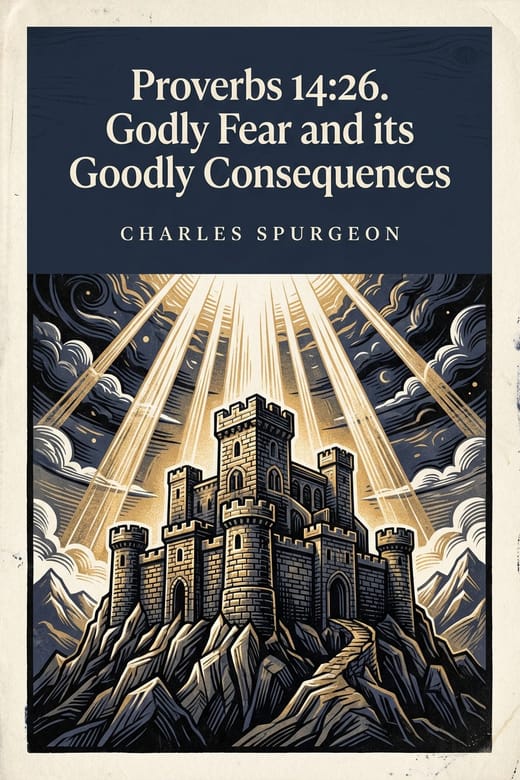
Strong towers were a greater security in a bygone age than they are now. Then, when troops of marauders invaded the land, strong castles were set upon the various hill-tops and the inhabitants gathered up their little wealth and fled thither at once. Castles were looked upon as being very difficult places for attack; and ancient troops would rather fight a hundred battles than endure a single siege. Towns which would be taken by modern artillery in twelve hours held out for twelve years against the most potent forces of the ancient times. He that possessed a castle was lord of all the region round about, and made their inhabitants either his clients who sought his protection or his dependents whom he ruled at will. He who owned a strong tower felt, however potent might be his adversary, his walls and bulwarks would be his sure salvation. Generous rulers provided strongholds for their people; mountain fortresses where the peasantry might be sheltered from marauders. Transfer your thoughts to a thousand years ago, and picture a people who after ploughing and sowing, have gathered in their harvest, but when they are about to make merry with the harvest festival, a startling signal banishes their joy. A trumpet is blown from yonder mountain, the tocsin answers it from the village tower, hordes of ferocious robbers are approaching, their corn will be devoured by strangers. Burying their corn and furniture and gathering up the little portable wealth they have, they hasten with all their might to their tower of defense which stands on yonder ridge. The gates are shut; the drawbridge is pulled up; the portcullis is let down; the warders are on the battlements, and the inhabitants within feel that they are safe. The enemy will rifle their deserted farms, and search for hidden treasure, and finding that the inhabitants are quite beyond their reach, they will betake themselves to some other place. Such is the figure which is in the text. “The name of the Lord is a strong tower: the righteous runs into it, and is safe.”
1. Of course we all know that by the name of God is meant the character of the Most High, so that our first lesson is that *the character of God furnishes the righteous with an abundant security*.
The character of God is the refuge of the Christian, *in opposition to other refuges* which godless men have chosen. Solomon suggestively puts the following words in the next verse— “The rich man's *wealth* is his strong city, and as a high wall in his own conceit.” The rich man feels that his wealth may afford him comfort. Should he be attacked in law, his wealth can procure him an advocate; should he be insulted in the streets, the dignity of a full purse will avenge him; should he be sick, he can fee the best physicians; should he need ministers to his pleasures, or helpers of his infirmities, they will be at his call; should famine stalk through the land, it will avoid his door; should war itself break forth he can purchase an escape from the sword, for his wealth is his strong tower. In contradistinction to this, the righteous man finds in his God all that the wealthy man finds in his substance, and a vast deal more. “The Lord is my portion, says my soul; therefore will I trust in him.” God is our treasure; he is to us better than the fullest purse, or the most magnificent income; broad acres yield not such peace as a well attested interest in the love and faithfulness of our heavenly Father. Provinces under our sway could not bring to us greater revenues than we possess in him who makes us heirs of all things by Christ Jesus. Other men who trust not in their wealth, nevertheless make *their own names* a strong tower. To say the truth, a man's good name is no mean defense against the attacks of his fellow men. To wrap oneself about in the garment of integrity is to defy the chill blast of calumny, and to be mailed against the arrows of slander. If we can appeal to God and say, “Lord, thou knowest that in this thing I am not wicked,” then let the mouth of the liar pour forth his slanders, let him scatter his venom where he may, we bear an antidote within before which his poison yields its power. But this is only true in a very limited sense; death soon proves to men that their own good name can afford them no consolation, and under conviction of sin a good repute is no shelter. When conscience is awake, when the judgment is unbiased, when we come to know something of the law of God and of the justice of his character, we soon discover that self-righteousness is no hiding place for us, a crumbling battlement which will fall on the neck of him that hides behind it—a pasteboard fortification yielding to the first shock of the law—a refuge of lies to be beaten down with the great hailstones of eternal vengeance—such is the righteousness of man. The righteous trusts not in this; not his own name, but the name of his God, not his own character, but the character of the Most High is his strong tower. Numberless are those castles in the air to which men hasten in the hour of peril: ceremonies lift their towers into the clouds; professions pile their walls high as mountains, and works of the flesh paint their delusions till they seem substantial bulwarks; but all, all shall melt like snow and vanish like a mist. Happy is he who leaves the sand for the rock, the phantom for the substance.
The name of the Lord is a strong tower to the Christian, not only in opposition to other men's refuges, but *as a matter of fact* and reality. Even when he is not able to perceive it by experience, yet God's character is the refuge of the saint. If we come to the bottom of things, we shall find that the basis of the security of the believer lies in the character of God. I know you will tell me it is the covenant; but what is the covenant worth if God were changeable, unjust, untrue? I know you will tell me that the confidence of the believer is in the blood of Christ; but what were the blood of Christ if God were false; if after Christ had paid the ransom the Lord should deny him the ransomed, if after Christ had stood the substitute, the judge of men should yet visit upon our heads for whom he suffered our own guilt; if Jehovah could be unrighteous; if he could violate his promise and become faithless as we are, then I say that even the blood of Christ would afford us no security. You tell me that there is his promise, but again I remind you that the value of a man's promise must depend on his character. If God were not such that he cannot lie, if he were not so faithful that he cannot repent, if he were not so mighty that he cannot be frustrated when he intends to perform, then his promise were but waste paper; his words like our words would be but wind, and afford no satisfactory shelter for a soul distressed and anxious. But you will tell me he has sworn with an oath. Brethren, I know he has. He has given us two immutable things in which it is impossible for him to lie that we may have strong consolation. But still what is a man's oath worth irrespective of his character? Is it not after all what a man is that makes his asseveration to be eminently mistrusted or profoundly believed? And it is because our God cannot by any means forswear himself but must be true, that his oath becomes of value to you and to me. Brethren, after all, let us remember that the purpose of God in our salvation is the glorifying of his own character, and this it is that makes our salvation positively sure. If everyone that trusts in Christ be not saved then is God dishonored, the Lord of Hosts hath hung up his escutcheon, and if in the face of the whole earth he accomplisheth not that which he declares he will perform in this book, then is his escutcheon stained. I say it, he hath flung down the gauntlet to sin, and death, and hell, and if he be not the conqueror over all these in the heart of every soul that trusts in him, then he is no more the God of Victories, nor can we shout his everlasting praise as the Lord mighty in battle. His character then, you see, when we come to the basis of all, is the great granite formation upon which must rest all the pillars of the covenant of grace and the sure mercies thereof. His wisdom, truth, mercy, justice, power, eternity, and immutability, are the seven pillars of the house of sure salvation. If we would have comfort, we can surely find it in the character of God. This is our strong tower, we run into it and we are safe.
Mark you beloved, not only is this true as a matter of fact, but it is true *as a matter of experience*. I hope I shall now speak the feelings of your hearts while I say we have found the character of God to be an abundant safeguard to us. We have known full well the trials of life; thank God we have, for what would any of us be worth if we had no troubles? Troubles like files take away our rust; like furnaces they consume our dross; like winnowing-fans they drive away the chaff, and we should have had but little value, we should have had but little usefulness if we had not been made to pass through the furnace. But in all our troubles we have found the character of God a comfort. You have been poor—very poor: I know some of you here have been out of work a long time, and you have wondered where your bread would come from even for the next meal. Now what has been your comfort? Have you not said, “God is too good to let me starve; he is too bountiful to let me want.” And so you see you have found his character to be your strong tower. Or else you have had personal sickness; you have long lain on the bed of weariness, tossing to and fro, and then the temptation has come into your heart to be impatient: “God has dealt hardly with you,” so the Evil One whispers; but how do you escape? Why, you say, “No, he is no tyrant, I know him to be a sympathizing God.” “In all their afflictions he was afflicted, the angel of his presence saved them.” Or else you have had losses—many losses, and you have been apt to ask, “How can these things be? How is it I have to work so long and plod so hard, and have to look about me with all my wits to earn but little, and yet when I have made money it melts? I see my wealth, like a flock of birds upon the fields, here one moment and gone the next, for a passer-by claps his hand and everything takes to itself wings and flies away.” Then we are apt to think that God is unwise to let us toil for naught; but lo, we run into our strong tower and we feel it cannot be. No; the God who sent this affliction could not have acted in a thoughtless, reckless, wisdomless manner; there must be something here that shall work for my good. You know brethren, it is useless for me to attempt to describe the various ways in which your trials come; but I am sure they that know Jehovah's name will put their trust in him. Perhaps your trial has been want, and then you have said “His name is Jehovah-Jireh, the Lord will provide.” Or else you have been banished from friends, perhaps from country, but you have said, “Ah! his name is Jehovah-Shammah, the Lord is there.” Or else you have had a disturbance in your family; there has been war within and war without, but you have run into your strong tower, for you have said, “His name is Jehovah-Shalom, the Lord send peace.” Or else the world has slandered you, and you yourself have been conscious of sin, but you have said, “His name is Jehovah-Tsidkenu, the Lord our righteousness,” and so you have gone there and been safe. Or else many have been your enemies, then his name has been “Jehovah-Nissi, the Lord my banner;” and so he has been a strong tower to you. Defy then brethren—defy in God's strength tribulations of every sort and size. Say with the poet,
“There is a safe and secret place Beneath the wings divine, Reserved for all the heirs of grace; That refuge now is mine. The least and feeblest here may hide Uninjured and unawed; While thousands fall on every side, I rest secure in God.”
But, beloved, besides the trials of this life we have *the sins of the flesh,* and what a tribulation these are; but the name of our God is our strong tower then. At certain seasons we are more than ordinarily conscious of our guilt; and I would give little for your piety if you do not sometimes creep into a corner with the poor publican and say, “God be merciful to me a sinner.” Broken hearts and humble walkers, these are dear in Jesus' eyes. There will be times with all of us when our saintship is not very clear, but our sinnership is very apparent; well then, the name of our God must be our defense: “He is very merciful”—“For I will be merciful to their unrighteousness, and their sins and their iniquities will I remember no more.” Yea, in the person of Christ we even dare to look at his justice with confidence, since “He is faithful and just to forgive us our sins and to cleanse us from all unrighteousness.” Possibly it is not so much the guilt of sin that troubles you as the power of sin. You feel as if you must one day fall by the hand of this enemy within. You have been striving and struggling but the old Adam is too much for you. It is a stern conflict, and you fear that the sons of Anak will never be driven out. You feel you carry a bombshell within your heart; your passions are like a powder magazine; you are walking where the flakes of fire are flying, and you are afraid a spark may fall and then there will be a terrible destruction of everything. Ah! then there is the power of God, there is the truth of God, there is the faithfulness of God, and despite all the desperate power of sin we find a shelter here in the character of the Most High. Sin sometimes comes with all the terrors of the law; then, if you know not how to hide yourself behind your God, you will be in an evil plight. It will come at times with all the fire of the flesh, and if you cannot perceive that your flesh was crucified in Christ and that your life is a life in him, and not in yourself, then will you soon be put to the rout. But he who lives in his God and not in himself, and he who wraps Christ's righteousness about him, and is righteous in Christ, such a man may defy all the attacks of the flesh and all the temptations of the world; he shall overcome through the blood of the Lamb. “This is the victory that overcomes the world, even our faith.”
Then beloved, there are the temptations of the devil, and these are very dreadful; but how sweet it is still to feel that the character of God is our strong tower. Without walls of grace and bulwarks of mercy how can a tempted soul escape the clutches of the archdestroyer? But where the soul lies in the entrenchments of divine promise, all the devils in hell cannot carry it by storm. I saw this week one whom many of you greatly respect—the former pastor of this Church, Mister James Smith of Cheltenham [since departed “to be with Christ, which is far better.”]—a name well known by his innumerable little works which are scattered everywhere and cannot fail to do good. You will remember that about a year ago he was struck with paralysis, and one half of his body is dead. But yet when I saw him on the bed I had not seen a more cheerful man in the full heyday of strength. I had been told that he was the subject of very fearful conflicts at times; so after I had shaken hands with him I said, “Friend Smith, I hear you have many doubts and fears!” “Who told you that?” said he, “for I have none.” “Never have any? why, I understood you had many conflicts.” “Yes,” he said, “I have many conflicts, but I have no doubts; I have many wars within but I have no fears. Who could have told you that? I hope I have not led any one to think that. It is a hard battle but I know the victory is sure. After I have had an ill night's rest—of course, through physical debility—my mind is troubled, and then that old coward Satan who would be afraid to meddle with me perhaps if I were strong, attacks me when I am weak; but I am not afraid of him; do not you go away with that opinion; he does throw many fiery darts at me but I have no doubt as to my final victory.” Then he said, in his own way, “I am just like a packet that is all ready to go by train, packed, corded, labelled, paid for, and on the platform, waiting for the express to come by and take me to glory. I wish I could hear the whistle now,” said he, “I had hoped I should have been carried to heaven long ago; but still I am fine.” “And then,” he said, “I have been telling your George Moore over there that I am not only on the rock, but that I am cemented *to* the rock, and that the cement is as hard as the rock so there is no fear of my perishing; unless the rock falls I cannot; unless the gospel perishes I cannot perish.” Now, here was a man attacked by Satan; he did not tell me of the bitter conflicts he had within, I know they were severe enough; he was anxious to bear a good testimony to the faithfulness of his gracious Lord; but you see it was his God that was his stronghold; he ran to this—the immutability, the faithfulness, the truthfulness, the mightiness of that God upon whose arm he leaned. If you and I will do the same, we can always find an attribute of God to oppose each suggestion of the Evil One. “God will leave you,” says the Evil One. “You old liar, he cannot for he is a faithful God.” “But you will perish after all.” “O you vile deceiver, that can never be for he is a mighty God and strong to deliver.” “But one of these times he will abhor you.” “No; you false accuser and father of lies, that cannot be for he is a God of love.” “The time shall happen when he shall forget you.” “No, traitor; that cannot be for he is a God omniscient and knows and sees all things.” I say, thus we may rebut every mischievous slander of Satan, running still into the character of God as our strong tower.
Brethren, even when the Lord himself chastens us, it is most blessed to appeal against God to God. Do you understand what I mean? He smites us with his rod, but then to look up and say, “Father, if I could believe what thy rod seems to say, I should say thou lovest me not; but I know thou art a God of love, and my faith tells me that thou lovest me none the less because of that hard blow.” See here brethren, I will put myself in the case a moment—Lo, He spurns me as though he hated me; drives me from his presence; gives me no caresses; denies me sweet promises; shuts me up in prison, and gives me the water of affliction and the bread of distress; but my faith declares, “He is such a God that I cannot think hardly of him; he has been so good to me that I know he is good now, and in the teeth of all his providences, even when he puts a black mask over his face, I still believe that
“Behind a frowning providence, He hides a smiling face.”
But, friends, I hope you know, I hope each of us may know by experience the blessed art of running into the bosom of God and hiding therein.
This word is to the sinner who has not yet found peace. Do not you see, man, the Christian is not saved by what he is, but by what his God is, and this is the groundwork of our comfort—that God is perfect, not that we are perfect. When I preached last Thursday night about the snuffers of the temple and the golden snuffer trays, and the necessity there was for the lamps in the sanctuary to be trimmed, one foolish woman said, “Ah, you see, according to the minister's own confession these Christians are as bad as the rest of us, they have many faults; oh!” said she, “I dare say I shall be as well off at the last as they will.” Poor soul! She did not see that the Christian's hope does not lie in what he is, but in what Christ is; our trust is not in what we suffer, but in what Jesus suffered; not in what *we* do, but in what *He* has done. It is not our name I say again that is a strong tower to us, it is not even our prayer, it is not our good works; it is the name, the promise, the truth, the work, the finished righteousness of our God in Christ Jesus. Here the believer finds his defense and nowhere besides. Run sinner, run, for the castle gate is free to all who seek a shelter, be they who they may.
2. By your leave I shall turn to the second point. *How the righteous avail themselves of this strong tower*. They run into it. Now running seems to me to imply that *they do not stop to make any preparation*. You will remember our Lord Jesus Christ said to his disciples that when the Romans surrounded Jerusalem, he that was on the house-top was not to come down into his house, but to run down the outer staircase and escape. So the Christian, when he is attacked by his enemies, should not stop for anything but just run into his God and be safe. There is no need for you to tarry until you have prepared your mind, until you have performed sundry ablutions, but run man, straight away at once. When the pigeons are attacked by the hawk their better plan is not to parley, nor to stay, but swift as they can cut the air and fly to the dove-cote. So be it with you. Leave fools who will to parley with the fiend of hell; but as for you, fly to your God and enter into his secret places till the tempest be over past. A gracious hint is this to you anxious souls who are seeking to fit yourselves for Jesus. Away with such legal rubbish, run at once; you are safe in following the good example of the righteous.
This running appears to me to imply that *they have nothing to carry*. A man who has a load, the heavier the load may be, the more will he be impeded in his flight. But the righteous run like racers in the games who have thrown off everything; their sins they leave to mercy and their righteousness to the moles and bats. If I had any righteousness I would not carry it, but run to the righteousness of Christ without it; for my own righteousness must be a drag upon me which I could not bear. Sinners I know, when they come to Christ, want to bring tons of good works, wagon loads of good feelings, and fitnesses, and repentings, and such like; but the righteous do no such thing; they just foreswear everything they have of their own, and count it but dross and dung that they may run to Christ and be found in him. Gospel righteousness lies all in Jesus, not in the believer.
It seems to me too that this expression not only implies a want of preparation and having nothing to carry, but it imports that *fear quickens them*. Men do not run to a castle unless they are afraid. But when the avenger of death is close behind, then swiftly they fly. It is marvelous how godly fear helps faith. There is a man sinking there in the river; he cannot swim, he *must* be drowned! See! see he is going down! We push him a plank; with what a clutch he grasps it; and the more he is convinced that he has no power to float, the more firmly does he grip at this one hope. Fear may even drive a man, I say, to faith, and lend him wings to fly where else he might have crept with laggard feet. The flight is the flight of fear, but the refuge is the refuge of faith. O sinner, if the righteous fly, what ought your pace to be? Again, it seems to me that *there is great eagerness here*, as if the Christian did not feel safe till he had entered into his God. And therefore, as the stag pursued by the hounds quickens its flight by reason of the baying of the dogs as the clamor grows louder and louder, see how the stag leaps from crag to crag, dashes through the stream, flies over yonder hill, is lost in yonder brake and anon springs through the valley; so the Christian flies to his dear God for safety when the hounds of hell and the dogs of temptation are let loose against him. Eagerness! Where indeed shall the like be found? “As the hart pants after the water brooks, so pants my soul after thee, O God. My soul thirsts for God, for the living God: when shall I come and appear before God?” O convinced sinner, what should your eagerness be if thus the righteous pant for God? Brethren, I may add here that there is an *absence of all hesitation*. He runs. You know if we want somebody to help us we put our hand to our brow and consider, “Let us see, where shall we go? I am in great straits, to whom shall I fly? Who will be the best friend to me?” The righteous never ask that question, at least when they are in a right mind they never do; but the moment their trouble comes they run at once to their God for they feel that they have full permission to repair to him; and again they feel they have nowhere else to fly. “To whom, or whither should I go if I could turn from thee?” is a question which is its own answer. Then understand in our text there is eagerness, the absence of all hesitation; there is fear and yet there is courage; there is no preparation, there is the flinging aside of every burden. “The righteous runs into his high tower, and is safe.”
Beloved, I will leave that point when I have just said, please remember that when a man gets into a castle he is safe because of the impregnability of the castle; he is not safe because of the way in which he entered into the castle. You hear some man inside saying, “I shall never be hurt because I came into the castle the right way.” You will tell him, “No, no, no, it is not the way you came into the castle, but the castle itself is our defense.” So some of you may be thinking, “I do come to Christ, but I am afraid that I do not come aright.” But it is not *your coming,* it is Christ that saves you. If you are in Christ I do not care a pin how you got in, for I am sure you could not get in except by the door; if you are once in he will never throw you out; he will never drive away a soul that comes unto him for any reason whatsoever. Your safety does not lie in how you came, for in very truth your safety is in Him. If a man should run into a castle and carry all the jewels of a kingdom with him, he would not be safer because of the jewels; and if another man should run in with hardly a fresh suit of clothes with him, he would not be any the more in danger because of his raggedness. It is the castle, it is the castle, not the man. The solid walls, the strong bastions, the frowning ramparts, the mighty munitions, these make up the defense, not the man, nor yet the man's wealth, nor yet the way the man came. Beloved, it is most true that salvation is of the Lord, and whosoever shall look out of self tonight, whosoever shall look to Christ only shall find him to be a strong tower, he may run into his Lord and be safe.
3. And now for our third and closing remark. You that have Bibles with margins, just look at them. You will find that the second part of the text is put in the margin thus—“The righteous runs into it, and is set aloft.” Our first rendering is, “The righteous runs into it, and is safe”—there is the matter of fact. The other rendering is, “He is set aloft”—there is the matter of joyous experience.
1. Now first let us see to the *matter of fact*. The man that is sheltered in his God—a man that dwells in the secret places of the tabernacle of the Most High, who is hidden in his pavilion, and is set upon a rock, he is safe; for first, *who can hurt him?* The Devil? Christ has broken his head. Life? Christ has taken his life up to heaven; for we are dead, and “our life is hid with Christ in God.” Death? No; the last enemy that shall be destroyed is death. “O death, where is your sting? O grave, where is your victory?” The law? That is satisfied and it is dead to the believer, and he is not under its curse. Sin? No; that cannot hurt the believer, for Christ has slain it. Christ took the believer's sins upon himself and therefore they are not on the believer any more. Christ took the believer's sins and threw them into the Red Sea of his atoning blood; the depths have covered them, not one of them is left. All the sin the believer has ever committed is now blotted out, and a debt that is canceled can never put a man in prison; a debt that is paid, let it be never so heavy, can never make a man an insolvent—it is discharged, it has ceased to be. “Who shall lay anything to the charge of God's elect? It is God that justifies. Who is he that condemns? It is Christ that died, yea rather, that is risen again, who is even at the right hand of God, who also makes intercession for us.” Who can harm us? Let him have permission to do what he will; what is there that he can do? *Who again has the power to reach us?* We are in the hand of Christ. What arrow shall penetrate his hand to reach our souls? We are under the skirts of Deity. What strength shall tear away the mantle of God to reach his beloved? Our names are written on the hands of Jesus, who can erase those everlasting lines? We are jewels in Immanuel's crown. What thievish fingers shall steal away those jewels? We are in Christ. Who shall be able to rend us from his innermost heart? We are members of his body. Who shall mutilate the Savior? “I bore you,” says God, “as on eagles' wings.” Who shall smite through the breast of the Eternal One, heaven's great eagle? He must first do it before he can reach the eaglets, the young sons of God, begotten unto a lively hope. Who can reach us? God interposes; Christ stands in the way; and the Holy Spirit guards us as a garrison. Who shall stand against the Omnipotent? Tens of thousands of created powers must fall before him, for in the Lord Jehovah is everlasting strength. *What weapon is there that can be used against us?* Shall they kill us? Then we begin to live. Shall they banish us? Then we are but nearer to our home. Shall they strip us? How can they rend away the garment of imputed righteousness? Shall they seize our property? How can they touch our treasure since it is all in heaven? Shall they scourge us? Sweet shall be the smart when Christ is present with us. Shall they cast us into a dungeon? Where shall the free spirit find a prison? What fetters can bind the man who is free in Christ? Shall the tongue attack us? Every tongue that rises against us in judgment we shall condemn. I know not what new weapon can be formed, for certain it is that the anvil of the Church has broken all the hammers that were ever used to smite it, and it remains uninjured still. The believer is—he must be safe. I said this morning that if the believer in Christ be not saved for ever, then, beloved, there is no meaning whatever in God's Word; and I say it once again, and I say it without any word of apology for so doing, I could never receive that book as the book of God at all if it could be proved to me that it did not teach the doctrine of the safety of those that trust in Christ. I could never believe that God would speak in such a manner as to make tens of thousands of us, yea millions of us, believe that He would keep us, and yet after all he should cast us away. Nor do I believe that he would use words which, to say the very least, seem to teach final perseverance if he had not intended to teach us the doctrine. All the Arminian divines that ever lived cannot prove the total apostasy of believers; they can attack some other points of the Calvinistic doctrine; there are some points of our form of doctrine which apparently are far more vulnerable. God forbid we should be so foolish as to deny that there are difficulties about every system of theology, but about the perseverance of the saints there is no difficulty. It is as easy to overthrow an opponent here as it would be to pierce with a spear through a shield of pasteboard. Be confident, believer, that this is God's truth, that they who trust in God shall be as Mount Zion which shall never be removed, but abides for ever.
2. But now we conclude by noticing that our text not only teaches us our safety, but *our experience of it*. “He shall set him up aloft.” The believer in his high-days, and they ought to be every day, is like an eagle perched aloft on a towering crag. Yonder is a hunter down below who would fain strike the royal bird; he has his rifle with him, but his rifle would not reach one third of the way; so the royal bird looks down upon him, sees him load and prime and aim, and looks in quiet contempt on him, not intending even to take the trouble to stretch one of his wings; he sees him load again, hears the bullet down below, but he is quite safe for he is up aloft. Such is the faithful Christian's state before God. He can look down upon every trial and temptation; upon every adversary and every malicious attack, for God is his strong tower and “he is set up aloft.” When some people go to the newspaper and write a very sharp, bitter, and cutting letter against the minister, oh, think they, “How he will feel that; how that will cut him to the quick!” And yet if they had seen the man read it through, double it up, and throw it into the fire, saying, “What a mercy it is to have somebody taking notice of me;” if they could see the man go to bed and sleep all the better because he thinks he has had a high honor conferred on him for being allowed to be abused for Christ, surely they would see that their efforts are only “hate's labor lost.” I do not think our enemies would take so much trouble to make us happy if they knew how blessed we are under their malice. “Thou hast prepared a table before me in the presence of mine enemies,” said David. Some soldiers never eat so well as when their enemies are looking on; for there is a sort of gusto about every mouthful which they eat, as they seem to say, “snatched from the jaw of the lion, and from the paw of the bear, and in defiance of you all, in the name of the Most High God I feast to the full, and then set up my banner.” The Lord sets his people up aloft. There are many who do not appear to be much up aloft. You meet them on the corn market, and they say, “Wheats do not pay as they used to; farming is no good to anybody.” Hear others after those gales, those equinoctial gales, when so many ships have gone down, say, “Ah! you may well pity us poor fellows that have to do with shipping, dreadful times these, we are all sure to be ruined.” See many of our tradesmen—“This Exhibition has given us a little spurt, but as soon as this is over there will be nothing doing; trade never was so dull.” Trade has been dull ever since I have been in London, and that is nine years! I do not know how it is, but our friends are always losing money, yet they get on pretty comfortably too. Some I know began with nothing; and they are getting pretty rich now, but it is all with losing money if I am to believe what they tell me. Surely this is not sitting up aloft; surely this is not living up on high. This is a low kind of life for a child of God. We should not have liked to see the Prince of Wales in his boyhood playing with the children in the street, and I do not suppose you would like to see him now among coal-heavers at a wrestling match. Nor should the child of God be seen pushing and grasping as if this world were all, always using that muck-rake to scrape together the things of this world; instead of in full satisfaction being content with such things as he has, for God has said, “I will never leave thee nor forsake thee.” I am not a little ashamed of myself that I do not live more on high, for I know when we get depressed in spirits and downcast and doubting we say many unbelieving and God-dishonoring words. It is all wrong. We ought not to stay here in these marshes of fleshly doubts. We ought never to doubt our God. Let the heathen doubt his God, for well he may, but our God made the heavens. What a happy people you ought to be! When we are not we are not true to our principles. There are ten thousand arguments in Scripture for happiness in the Christian; but I do not know that there is one logical argument for misery. Those people who draw their faces down, and like the hypocrites pretend to be of a sad countenance, these, I say, cry, “Lord, what a wretched land is this that yields us no supplies.” I should think they do not belong to the children of Israel; for the children of Israel find in the wilderness a rock following them with its streams of water, and manna dropping every day, and when they want them there are the quails and so the wretched land is filled with good supplies. Let us rather rejoice in our God. I should not like to have a serving man who always went about with a dreary countenance, because you know people would say “What a bad master that man has.” And when we see Christians looking so sad we are apt to think they cannot have a good God to trust to. Come, beloved, let us change our notes, for we have a strong tower and are safe. Let us take a walk upon the ramparts, I do not see any reason for always being down in the dungeon; let us go up to the very top of the ramparts where the banner waves in the fresh air and let us sound the clarion of defiance to our foes again, and let it ring across the plain where yonder pale white-horsed rider comes, bearing the lance of death; let us defy even him. Ring out the note again; salute the evening, and make the outgoings of the morning to rejoice. Warder upon the castle-top, shout to your companion yonder and let every tower and every turret of the grand old battlements be vocal with the praise of him who has said—
“Munitions of stupendous rock, Your dwelling-place shall be; There shall your soul without a shock The wreck of nature see.”
Sinner, again I say the door is open; run to the mercy of God in Christ and be safe.
*Portion of Scripture read before sermon*— Proverbs 17.
A sermon (Number 491) delivered on Lord's Day Evening, October 26th, 1862, at the Metropolitan Tabernacle, Newington, by C. H. Spurgeon.
"The name of the Lord is a strong tower: the righteous runs into it, and is safe." {safe: Hebrew set aloft} — Proverbs 18:10.
Strong towers offered far greater security in earlier ages than they do today. When bands of raiders invaded the land, people built strong castles on hilltops, and the inhabitants would gather their valuables and flee there immediately. Castles were considered very difficult to attack, and ancient armies would rather fight a hundred open battles than endure a single siege. Towns that modern artillery could take in twelve hours once held out for twelve years against the most powerful forces of the ancient world. The man who owned a castle was lord of all the surrounding region, making the people either his clients who sought his protection or his dependents whom he ruled as he pleased. The owner of a strong tower felt confident that, no matter how powerful his enemy, his walls and fortifications would keep him safe. Generous rulers built strongholds for their people — mountain fortresses where ordinary citizens could find shelter from raiders. Imagine life a thousand years ago: a community that has plowed, sown, and gathered in the harvest is just about to celebrate with a harvest festival when a startling signal destroys their joy. A trumpet sounds from the mountain, a warning bell answers from the village tower — hordes of fierce robbers are approaching, and strangers will devour their grain. The people bury their grain and furniture, grab whatever portable valuables they have, and race with all their strength toward their defensive tower on the nearby ridge. The gates are shut, the drawbridge is raised, the portcullis drops, the guards take their posts on the battlements, and those inside feel safe. The enemy will ransack the abandoned farms and search for hidden treasure, but finding the inhabitants completely out of reach, they will move on to some other place. That is the picture behind our text. "The name of the Lord is a strong tower: the righteous runs into it, and is safe."
1. We all understand that by the name of God we mean the character of the Most High, so our first lesson is this: the character of God gives the righteous person abundant security.
The character of God is the Christian's refuge, in contrast to the other refuges that godless people have chosen. Solomon pointedly places these words in the very next verse: "The rich man's wealth is his strong city, and as a high wall in his own conceit." The rich man believes his wealth can comfort him in any situation. If he faces a lawsuit, his money can hire him an advocate; if he is insulted in the street, the dignity of a full wallet can avenge him; if he falls ill, he can pay the best doctors; if he wants servants for his pleasures or helpers for his weaknesses, they will come at his call; if famine spreads through the land, it will pass by his door; and if war breaks out, he can buy his way out of danger — his wealth is his strong tower. In contrast, the righteous person finds in God everything the wealthy person finds in money, and far more besides. "The Lord is my portion, says my soul; therefore I will trust in Him." God is our treasure. He is worth more to us than the largest fortune or the greatest income. Vast estates bring nothing like the peace that comes from knowing with certainty that we stand in the love and faithfulness of our heavenly Father. All the provinces one could rule could not bring greater riches than we already possess in Him who makes us heirs of all things through Christ Jesus. Other people who do not trust in wealth nevertheless make their own good name a strong tower. To be honest, a good reputation is no small defense against attacks from others. To wrap yourself in a garment of integrity is to stand against the cold blast of gossip and to be armored against the arrows of slander. If we can appeal to God and say, "Lord, You know that in this matter I have done no wrong," then let the liar pour out his slanders and scatter his poison wherever he will — we carry an antidote within us that neutralizes his venom. But this is only true in a very limited sense. Death quickly proves to people that a good reputation can offer them no comfort, and under the conviction of sin, a good name is no shelter at all. When conscience is awake, when judgment is unbiased, when we begin to understand God's law and the justice of His character, we quickly discover that self-righteousness is no hiding place. It is a crumbling battlement that will fall on the head of anyone who hides behind it — a cardboard fortress that collapses at the first blow of the law — a refuge of lies that will be beaten down by the great hailstones of eternal judgment. That is what human righteousness amounts to. The righteous person does not trust in this. Not his own name but the name of his God — not his own character but the character of the Most High — is his strong tower. Countless are the castles in the air to which people flee in times of danger: religious ceremonies lift their towers into the clouds, outward professions pile their walls high as mountains, and works of the flesh paint their illusions until they look like solid defenses — but all, every one of them, will melt like snow and vanish like mist. Happy is the person who leaves the sand for the rock, and the phantom for the real thing.
The name of the Lord is a strong tower for the Christian not only in contrast to what other people trust in, but as an actual, objective fact. Even when a believer cannot feel it by experience, God's character is still the saint's refuge. When we get to the foundation of things, we find that the basis of the believer's security lies in the character of God. You may tell me it is the covenant — but what is the covenant worth if God were changeable, unjust, or untrue? You may tell me the believer's confidence rests in the blood of Christ — but what would the blood of Christ mean if God were false? If after Christ paid the ransom, God denied Him the ransomed souls; if after Christ stood as our substitute, the judge still punished us for the very sins He bore; if God could be unrighteous, could break His promise and become faithless as we are — then I say that even the blood of Christ would give us no security. You may point to His promise, but again I remind you that the value of any promise depends entirely on the character of the one who made it. If God were not the kind of God who cannot lie, if He were not so faithful that He cannot go back on His word, if He were not so mighty that nothing can stop Him when He intends to act — then His promise would be worthless; His words, like our words, would be mere wind, offering no real shelter to a troubled and anxious soul. But you will say He has confirmed it with an oath. I know He has. He has given us two unchangeable things in which it is impossible for Him to lie, so that we might have strong comfort. But still — what is any person's oath worth apart from their character? Is it not, in the end, what a person actually is that makes their word either deeply trusted or deeply doubted? It is precisely because our God cannot go back on His word and must always be true that His oath becomes precious to you and me. After all is said, let us remember that God's purpose in our salvation is the glorifying of His own character — and that is what makes our salvation absolutely certain. If everyone who trusts in Christ is not saved, then God is dishonored. He has put His name on display before the whole earth, and if He does not accomplish what He declares He will do in this book, His honor is stained. He has thrown down the gauntlet to sin, death, and hell, and if He does not conquer all of these in the heart of every soul that trusts in Him, then He is no longer the God of victories, and we cannot shout His everlasting praise as the Lord mighty in battle. His character, then, when we reach the very bottom of everything, is the great granite foundation on which all the pillars of the covenant of grace and its sure mercies must rest. His wisdom, truth, mercy, justice, power, eternity, and unchangeableness are the seven pillars of the house of sure salvation. If we want comfort, we can certainly find it in the character of God. This is our strong tower — we run into it and we are safe.
Notice, dear friends, that this is true not only as an objective fact but as a matter of personal experience. I hope I now speak what you yourselves have felt when I say we have found the character of God to be an abundant safeguard. We have known the trials of life well — and thank God we have, for what would any of us be worth without troubles? Troubles, like files, wear away our rust; like furnaces, they burn off our impurities; like winnowing fans, they drive away the chaff. We would have been worth far less, and far less useful, if we had not been made to pass through the furnace. But in all our troubles we have found the character of God to be a comfort. Some of you have been poor — very poor. I know some of you here have been out of work for a long time and have wondered where your next meal would come from. What has been your comfort in those moments? Have you not said, "God is too good to let me starve; He is too generous to let me go without"? And so you see, you have found His character to be your strong tower. Or perhaps you have suffered personal illness, lying on a bed of exhaustion for a long time, tossing back and forth, and the temptation has come to be impatient. "God has dealt harshly with you," the Evil One whispers. But how do you escape that thought? You say, "No, He is no tyrant. I know Him to be a sympathizing God." "In all their afflictions He was afflicted; the angel of His presence saved them." Or perhaps you have experienced many losses, and you have been tempted to ask, "How can these things be? How is it that I work so long, push so hard, use every bit of my wit to earn so little — and then when I do make money it seems to disappear? I watch my wealth like a flock of birds in a field: here one moment and gone the next, scattered by a single clap of hands, everything taking wing and flying away." Then we are tempted to think God is unwise to let us toil for nothing — but we run into our strong tower and feel it cannot be so. No — the God who sent this affliction could not have acted in a thoughtless or reckless way, without wisdom. There must be something here that will work for my good. I know it is impossible for me to describe all the different ways your trials come, but I am sure that those who know the name of the Lord will put their trust in Him. Perhaps your trial has been want, and you have said, "His name is Jehovah-Jireh — the Lord will provide." Or perhaps you have been separated from friends, maybe even from your homeland, but you have said, "His name is Jehovah-Shammah — the Lord is there." Or perhaps there has been conflict in your family, war inside and outside your home, but you have run into your strong tower saying, "His name is Jehovah-Shalom — the Lord sends peace." Or the world has slandered you, and you yourself have been painfully aware of your own sin, but you have said, "His name is Jehovah-Tsidkenu — the Lord our righteousness," and you have gone there and been safe. Or you have had many enemies, and His name has been "Jehovah-Nissi — the Lord my banner," and so He has been a strong tower to you. Therefore, brothers and sisters, defy — in God's strength — troubles of every kind and size. Say with the poet,
"There is a safe and secret place Beneath the wings divine, Reserved for all the heirs of grace; That refuge now is mine. The least and feeblest here may hide Uninjured and unawed; While thousands fall on every side, I rest secure in God."
But, dear friends, beyond the trials of this life we also face the sins of the flesh — and what a torment these are. Yet the name of our God is our strong tower even then. At certain times we are more than usually aware of our guilt, and I would think little of your faith if you do not sometimes slip into a corner with the poor tax collector and say, "God, be merciful to me, a sinner." Broken hearts and humble walkers — these are dear in Jesus' eyes. There will be times for all of us when our sainthood is not very obvious but our sinfulness is very apparent. In those moments, the name of our God must be our defense: "He is very merciful" — "For I will be merciful to their unrighteousness, and their sins and their lawless deeds I will remember no more." Yes, in the person of Christ we can even look at His justice with confidence, since "He is faithful and just to forgive us our sins and to cleanse us from all unrighteousness." Perhaps it is not so much the guilt of sin that troubles you as the power of sin. You feel as if you must one day fall to this enemy within. You have been striving and struggling, but the old sinful nature is too much for you. It is a fierce conflict, and you fear that the giants of sin will never be driven out. You feel you carry an explosive charge within your heart; your passions are like a powder magazine; you are walking where sparks are flying, and you are afraid one may land and cause a terrible explosion. But there is the power of God, the truth of God, the faithfulness of God — and despite the desperate strength of sin, we find shelter in the character of the Most High. Sin sometimes comes with all the terrors of the law. If you do not know how to hide yourself in God, you will be in a terrible position. At times it comes with all the fire of the flesh, and if you cannot see that your sinful nature was crucified in Christ and that your life is lived in Him rather than in yourself, you will quickly be put to flight. But the person who lives in God rather than in himself, who wraps Christ's righteousness around him and stands righteous in Christ — that person can defy all the attacks of the flesh and all the temptations of the world. He will overcome through the blood of the Lamb. "This is the victory that overcomes the world, even our faith."
Dear friends, there are also the temptations of the devil, and these are very dreadful. Yet how sweet it is to know that the character of God is still our strong tower. Without the walls of grace and the fortifications of mercy, how can a tempted soul escape the grip of the great destroyer? But where the soul shelters in the strongholds of divine promise, all the devils in hell cannot take it by storm. This week I visited a man whom many of you greatly respect — the former pastor of this church, Mr. James Smith of Cheltenham, who has since departed "to be with Christ, which is far better." His name is well known through the countless short works he produced, which are scattered everywhere and cannot fail to do good. You will remember that about a year ago he was struck with paralysis, and one half of his body was left without feeling. Yet when I saw him in that bed, I had not seen a more cheerful man even in the full strength of good health. I had been told he sometimes endured very frightening spiritual conflicts, so after I greeted him I said, "Friend Smith, I hear you have many doubts and fears!" "Who told you that?" he replied. "For I have none." "Never any? Why, I understood you had many conflicts." "Yes," he said, "I have many conflicts, but I have no doubts. I have many battles within, but I have no fears. Who could have told you that? I hope I have not led anyone to think that. It is a hard fight, but I know the victory is certain. After a bad night's sleep — caused, of course, by physical weakness — my mind gets troubled, and then that old coward Satan, who would probably be afraid to meddle with me if I were strong, attacks me when I am weak. But I am not afraid of him. Do not go away with that impression. He throws many fiery darts at me, but I have no doubt about my final victory." Then he said, in his own way, "I am just like a parcel that is all ready to go by train — packed, tied, labeled, paid for, and sitting on the platform, waiting for the express to come and take me to glory. I wish I could hear the whistle now," he said. "I had hoped I would have been carried to heaven long ago, but I am doing well." "And then," he said, "I have been telling your George Moore over there that I am not only on the rock but cemented to the rock, and the cement is as hard as the rock — so there is no danger of my perishing. Unless the rock falls, I cannot fall. Unless the Gospel perishes, I cannot perish." Here was a man under attack from Satan. He did not dwell on the bitter conflicts he faced — I know they were severe enough. He was eager to bear a good testimony to the faithfulness of his gracious Lord. And his strength came from his God, who was his stronghold. He ran to this: the unchangeableness, the faithfulness, the truthfulness, the mightiness of the God on whose arm he leaned. If you and I do the same, we can always find something in the character of God to answer every suggestion of the Evil One. "God will abandon you," says the Evil One. "You old liar — He cannot, for He is a faithful God." "But you will perish in the end." "You vile deceiver — that can never be, for He is a mighty God, strong to deliver." "But one day He will reject you." "No, false accuser and father of lies — that cannot be, for He is a God of love." "The time will come when He will forget you." "No, traitor — that cannot be, for He is an all-knowing God who sees and knows all things." In this way we can answer every wicked slander of Satan, running always into the character of God as our strong tower.
Brothers and sisters, even when the Lord Himself disciplines us, it is a great blessing to appeal against God to God. Do you understand what I mean? He strikes us with His rod, but then we look up and say, "Father, if I were to believe what Your rod seems to say, I would think You do not love me. But I know You are a God of love, and my faith tells me You love me no less because of that hard blow." Let me put myself in the situation for a moment. Consider: He turns away from me as though He hated me; He drives me from His presence; gives me no comfort; withholds sweet promises; shuts me up in a prison of affliction and gives me the water of suffering and the bread of distress. But my faith declares, "He is such a God that I cannot think badly of Him. He has been so good to me that I know He is good now, and in the face of all His dealings — even when He puts a dark mask over His face — I still believe that
"Behind a frowning providence, He hides a smiling face."
Dear friends, I hope you know — I hope each of us may know by experience — the blessed art of running into the arms of God and hiding there.
This word is for the sinner who has not yet found peace. Do you not see, friend, that the Christian is not saved by what he is but by what his God is? This is the foundation of our comfort — that God is perfect, not that we are perfect. When I preached last Thursday night about the snuffers of the temple, the golden snuffer trays, and the need to trim the lamps in the sanctuary, one foolish woman said, "You see, even by the minister's own admission these Christians are as bad as the rest of us — they have many faults. Oh!" she said, "I dare say I'll end up just as well as they will at the last." Poor soul. She did not see that the Christian's hope does not rest in what he is but in what Christ is. Our trust is not in what we suffer, but in what Jesus suffered. Not in what we do, but in what He has done. It is not our own name, I say again, that is a strong tower to us. It is not even our prayers, it is not our good works. It is the name, the promise, the truth, the work, the finished righteousness of our God in Christ Jesus. Here the believer finds his defense, and nowhere else. Run, sinner, run — for the castle gate is open to all who seek shelter, whoever they may be.
2. Now let us turn to the second point: how the righteous make use of this strong tower. They run into it. Running suggests to me that they do not stop to make any preparation. You will remember that our Lord Jesus Christ told His disciples that when the Romans surrounded Jerusalem, the man on the rooftop was not to go down into his house first but to run down the outside staircase and escape immediately. In the same way, when the Christian is attacked by his enemies, he should not stop for anything — just run straight to his God and be safe. There is no need to wait until you have prepared your mind or completed certain rituals. Run, man — straight away, at once. When pigeons are attacked by a hawk, their best plan is not to negotiate or delay but to cut through the air as fast as they can and fly to the dove-cote. So be it with you. Leave fools to negotiate with the enemy of hell. As for you, fly to your God and enter into His hiding place until the storm has passed. This is a gracious word for you who are anxiously trying to make yourself ready for Jesus. Away with such empty religious effort — run at once. You are safe in following the good example of the righteous.
This running also suggests to me that they have nothing to carry. The heavier a person's load, the more it slows them down in flight. But the righteous run like athletes who have stripped off everything. They leave their sins to mercy and their supposed righteousness to be forgotten entirely. If I had any righteousness of my own, I would not carry it — I would run to the righteousness of Christ without it, for my own righteousness would only weigh me down. Sinners, I know, when they come to Christ want to bring loads of good works, wagon-loads of good feelings, spiritual fitness, acts of repentance, and similar things. But the righteous do no such thing. They give up everything they have of their own and count it all loss and garbage, so they can run to Christ and be found in Him. Gospel righteousness lies entirely in Jesus, not in the believer.
It also seems to me that this running implies not just a lack of preparation and an absence of burdens, but that fear drives them forward. People do not run to a castle unless they are frightened. But when the pursuer of death is close behind, they fly with speed. It is remarkable how godly fear helps faith. Picture a man sinking in a river; he cannot swim and he is going under. Watch — he is going down! We push him a plank, and with what a grip he seizes it. The more convinced he is that he has no power to stay afloat, the more tightly he grips this one hope. Fear can actually drive a person to faith and give him wings to fly where otherwise he might have crept with slow and dragging feet. The flight is the flight of fear, but the refuge is the refuge of faith. Sinner, if the righteous fly, how fast should you be running? Notice too that there is great eagerness here, as if the Christian does not feel safe until he has entered into his God. Just as a deer chased by hounds runs faster as the baying grows louder and louder — leaping from crag to crag, dashing through the stream, flying over the hill, disappearing into the underbrush, then springing through the valley — so the Christian flies to his dear God for safety when the hounds of hell and the dogs of temptation are set loose against him. Eagerness! Where else can anything like it be found? "As the deer pants for the water brooks, so my soul pants for You, O God. My soul thirsts for God, for the living God: when shall I come and appear before God?" Convicted sinner, what should your eagerness be, if the righteous themselves pant for God like this? Brothers and sisters, I should add that there is also a complete absence of hesitation. He runs. You know that when we need help, we often pause and think, "Now, where should I go? I am in great trouble — who can help me? Who would be the best friend to turn to?" The righteous never ask that question — at least not when they are thinking clearly. The moment their trouble comes, they run straight to God, because they know they have full permission to come to Him, and they also know they have nowhere else to go. "Where would I go, or to whom would I turn, if I could turn from You?" is a question that answers itself. So in our text there is eagerness and an absence of all hesitation; there is fear and yet there is courage; there is no preparation and every burden is cast aside. "The righteous runs into his high tower, and is safe."
Dear friends, I will leave that point after saying just this: please remember that when a man gets into a castle, he is safe because of the strength of the castle — not because of the particular way he entered it. You hear someone inside saying, "I will never be hurt because I came into the castle the right way." You tell him, "No, no, no — it is not how you entered the castle that protects you. The castle itself is our defense." So some of you may be thinking, "I do come to Christ, but I am afraid I do not come in the right way." But it is not your coming that saves you — it is Christ. If you are in Christ, I care nothing about how you got in, for I am certain you could not have entered except through the door. And once you are in, He will never throw you out. He will never turn away a soul that comes to Him, for any reason whatsoever. Your safety does not lie in how you came, for in truth your safety is in Him. If a man ran into a castle carrying all the jewels of a kingdom, he would not be safer because of the jewels. And if another man ran in with barely the clothes on his back, he would not be in any more danger because of his poverty. It is the castle. It is the castle, not the man. The solid walls, the strong bastions, the towering ramparts, the mighty defenses — these make up the protection. Not the man, not the man's wealth, and not the way the man came in. Dear friends, it is absolutely true that salvation is of the Lord, and whoever looks away from himself tonight and looks to Christ alone will find Him to be a strong tower. He may run into his Lord and be safe.
3. Now for our third and closing point. If you have a Bible with marginal notes, look at them. You will find that the second part of the text is rendered in the margin as: "The righteous runs into it, and is set aloft." Our main translation reads, "The righteous runs into it, and is safe" — that is the statement of fact. The other rendering is, "He is set aloft" — that is the description of a joyful experience.
1. First, let us consider the matter of fact. The person sheltered in God — the one who dwells in the secret places of the tabernacle of the Most High, who is hidden in His pavilion and set upon a rock — is safe. For who can harm him? The Devil? Christ has crushed his head. Life itself? Christ has taken life up to heaven with Him, for we are dead, and "our life is hidden with Christ in God." Death? No — death is the last enemy to be destroyed. "O death, where is your sting? O grave, where is your victory?" The law? It is satisfied, and it has no more hold over the believer — he is not under its curse. Sin? No — sin cannot harm the believer, for Christ has defeated it. Christ took the believer's sins upon Himself, and so those sins are no longer on the believer. Christ took the believer's sins and threw them into the Red Sea of His atoning blood. The depths have covered them; not one remains. Every sin the believer has ever committed is now erased. A canceled debt can never put a man in prison; a debt that has been paid, however large it was, can never make a man bankrupt — it is discharged, it no longer exists. "Who will bring a charge against God's elect? It is God who justifies. Who is the one who condemns? It is Christ who died — yes, rather, who was raised — who is at the right hand of God, who also intercedes for us." Who can harm us? Let anyone who thinks he can try — what is there that he can actually do? Who has the power to reach us? We are in the hand of Christ. What arrow could pierce through His hand to reach our souls? We are sheltered under the covering of God Himself. What force could tear away the protection of God to reach His beloved? Our names are written on the hands of Jesus — who can erase those everlasting marks? We are jewels in Immanuel's crown. What thieving hand could steal those jewels? We are in Christ. Who could ever tear us from His innermost heart? We are members of His body. Who would mutilate the Savior to get to us? "I carried you," says God, "as on eagles' wings." Who could strike through the breast of the Eternal One, heaven's great eagle? He would have to do that first before he could reach the eaglets — the young children of God, born to a living hope. Who can reach us? God stands between; Christ stands in the way; and the Holy Spirit guards us like a garrison. Who can stand against the Almighty? Tens of thousands of created powers will fall before Him, for in the Lord Jehovah is everlasting strength. What weapon can be used against us? Will they kill us? Then we begin to truly live. Will they banish us? Then we are only brought closer to our home. Will they strip us? How can they tear away the garment of imputed righteousness? Will they seize our property? How can they touch our treasure, since it is all in heaven? Will they beat us? The pain will be sweet when Christ is present with us. Will they throw us into a dungeon? Where is the prison that can hold a free spirit? What chains can bind the man who is free in Christ? Will tongues attack us? Every tongue that rises against us in judgment we will condemn. I do not know what new weapon can be invented, but it is certain that the anvil of the Church has broken every hammer ever brought against it, and it stands unharmed to this day. The believer is — he must be — safe. I said this morning that if the believer in Christ is not saved forever, then there is no meaning at all in God's Word. I say it again, and without any apology: I could never accept that book as the Word of God if it could be proved to me that it does not teach the doctrine of the safety of those who trust in Christ. I could never believe that God would speak in such a way as to make tens of thousands — yes, millions — of us believe that He would keep us, only to cast us away in the end. Nor do I believe He would use words that clearly seem to teach the final perseverance of the saints if He had not intended to teach us exactly that doctrine. All the Arminian theologians who ever lived cannot prove that true believers can fall away completely. They can attack other points of Calvinist doctrine — there are some aspects of our system that appear more vulnerable. God forbid we should be so foolish as to deny that every system of theology has its difficulties. But concerning the perseverance of the saints, there is no difficulty. Defeating an opponent on this point is as easy as driving a spear through a cardboard shield. Be confident, believer — it is God's truth that those who trust in Him will be like Mount Zion, which cannot be moved but stands forever.
2. We close by noticing that our text teaches us not only our safety but our experience of it. "He shall set him up aloft." The believer on his best days — and they ought to be every day — is like an eagle perched high on a towering crag. Down below is a hunter who would love to bring down that magnificent bird. He has his rifle, but it cannot reach even a third of the way up. So the royal bird looks down at him, watches him load and aim, and regards him with quiet contempt — not even bothering to stretch a wing. He hears the shot fired below, but he is perfectly safe, for he is up aloft. That is the state of the faithful Christian before God. He can look down on every trial and temptation, every adversary and every hostile attack, for God is his strong tower and "he is set up aloft." When certain people write a sharp, bitter, cutting letter to the newspaper attacking the minister, they think, "How he will feel that! How it will cut him to the quick!" Yet if they could have seen the man read it through, fold it up, and throw it in the fire, saying, "What a mercy it is to have someone taking notice of me" — if they could have seen him go to bed and sleep all the better because he considered it an honor to be abused for Christ's sake — surely they would see that their efforts amount to nothing but wasted hostility. I do not think our enemies would take so much trouble to make us miserable if they knew how much we are blessed even under their malice. "You prepare a table before me in the presence of my enemies," said David. Some soldiers never eat as well as when their enemies are watching. There is a kind of relish in every bite, as if to say: "Snatched from the jaws of the lion and the paw of the bear, and in defiance of you all — in the name of the Most High God I feast to the full and raise my banner." The Lord sets His people up aloft. Yet many do not appear to live very high. You meet them at the grain market and they say, "Wheat prices aren't what they used to be; farming is no good for anyone." You hear others, after the great autumn storms when so many ships have gone down, say, "Oh, you may well pity us poor fellows who deal in shipping — dreadful times, we are all sure to be ruined." You see many in trade saying, "The Exhibition gave us a little boost, but once it's over there will be nothing doing; trade has never been so slow." Trade has been slow ever since I came to London, and that is nine years now. I do not know how it is, but our friends are always losing money, yet they get on well enough. Some I know started with nothing and are now doing quite well — but if I believe what they tell me, it has all happened while losing money. This is certainly not living aloft. This is not living on high. This is a low kind of life for a child of God. We would not have liked to see the Prince of Wales playing in the street with common children as a boy, and I do not imagine you would want to see him now among laborers at a wrestling match. Nor should the child of God be seen pushing and grasping as if this world were everything — always scraping together the things of this world with a muck-rake, instead of resting in full contentment with what he has. For God has said, "I will never leave you nor forsake you." I am not a little ashamed of myself that I do not live more on high, for I know that when we grow depressed and downcast and full of doubt, we speak many unbelieving and God-dishonoring words. It is all wrong. We ought not to stay here in these swamps of fleshly doubt. We should never doubt our God. Let the pagan doubt his god, for he has good reason to. But our God made the heavens. What a joyful people you ought to be! When we are not, we are not being true to what we believe. There are ten thousand reasons in Scripture for happiness as a Christian, but I do not know of a single logical argument for misery. Those who go about with long drawn faces and, like hypocrites, pretend to be sorrowful — these are the ones who cry, "Lord, what a wretched land this is that yields us nothing." I think they must not belong to the children of Israel, for the children of Israel found in the wilderness a rock following them with streams of water, manna falling every morning, and quail when they needed it — so even a "wretched land" was filled with good things. Let us rather rejoice in our God. I would not want a servant who always went around looking miserable, because people would say, "What a terrible master that man must have." And when we see Christians looking so sad, people naturally conclude they cannot have a very good God to trust in. Come, dear friends, let us change our tune, for we have a strong tower and we are safe. Let us walk on the ramparts. There is no reason to stay down in the dungeon. Let us climb to the very top where the banner waves in the fresh air, sound the call of defiance to our foes once more, and let it ring across the plain where yonder pale rider on his white horse comes bearing the lance of death. Let us defy even him. Ring out the note again; greet the evening; make the dawn shout for joy. Guard on the castle top, call out to your companion and let every tower and turret of the great old battlements ring with praise to Him who has said —
"Munitions of stupendous rock, Your dwelling-place shall be; There shall your soul without a shock The wreck of nature see."
Sinner, again I say — the door is open. Run to the mercy of God in Christ and be safe.
Portion of Scripture read before sermon — Proverbs 17.