
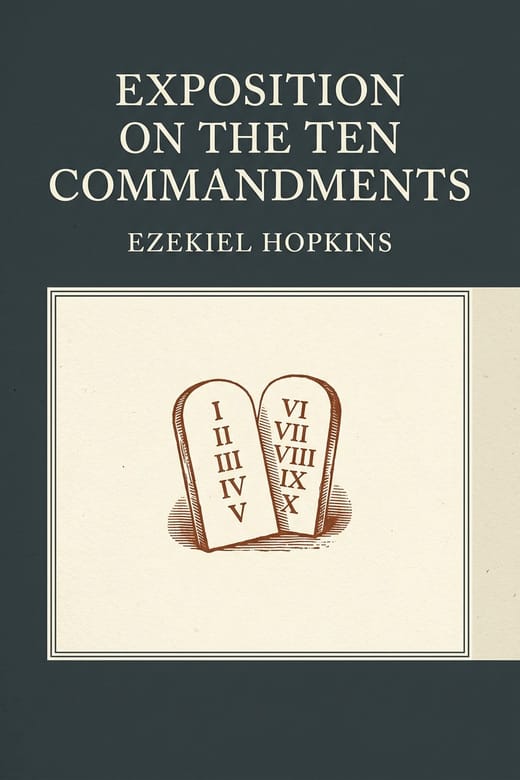
Cover of Exposition on the Ten Commandments

Classic Christian work

Exposition on the Ten Commandments

by Ezekiel Hopkins

A thorough exposition of the Decalogue by the Bishop of Londonderry, exploring each commandment's moral demands, spiritual implications, and practical applications for Christian life. Hopkins examines the breadth and depth of God's law, addressing both outward obedience and inward heart dispositions. The work concludes with two powerful sermons on the relationship between law and grace, warning against neglecting God's commands while pointing to Christ as the fulfillment of the law's demands.
Chapters
12
Word count
151,443
Type
Commentary
Start reading →

Table of contents

  1. 01 The First Commandment 38,123 words
  2. 02 The Second Commandment 12,411 words
  3. 03 The Third Commandment 8,276 words
  4. 04 The Fourth Commandment 10,253 words
  5. 05 The Fifth Commandment 36,087 words
  6. 06 The Sixth Commandment 8,214 words
  7. 07 The Seventh Commandment 4,008 words
  8. 08 The Eighth Commandment 6,676 words
  9. 09 The Ninth Commandment 10,916 words
  10. 10 The Tenth Commandment 3,544 words
  11. 11 A Sermon 8,010 words
  12. 12 A Sermon 4,260 words
Front matter (3 sections)

Frontispiece

portrait of Ezekiel Hopkins EZEKIEL HOPKINS EPISCOPUS DERENSIS. I. Sturt Sculp

Printed for Nathanael Ranew

Title Page

An Exposition on the Ten Commandments: With Other Sermons.

By the Right Reverend Father in GOD, Ezekiel, Late Lord Bishop of London-Derry.

London: Printed for Nathanael Ranew, at the Kings-Arms, Jonathan Robinson, at the Golden Lyon, and John Wyat, at the Rose in St. Paul's Church-yard. 1691.

To the Reader

The following book has so much of substantial worth, together with so many true beauties, as not to need recommendation: the design therefore of this address to you, good reader, is partly to assure you the work is genuine, partly to give you some light into the general nature of it, or what you are here to expect.

It was my happiness, many years ago, to contract a very intimate acquaintance, I might call it friendship, with that great person the author, while we lived neighbors in that flourishing, religious, and liberal city, where these discourses had their birth, and became first vocally public. And I doubt not, but that the memories of many of the citizens there, are a sufficient record, by the consulting of which, any who should scruple my testimony, as less competent, may receive plenary satisfaction. I being constantly employed myself, at the hours when this exposition was delivered, could not be an auditor of it. But as I then understood what subject my friend was treating on, so now reading the tract, I cannot but acknowledge the true spirit and style of the author.

All, I think, that can be doubted, is, whether he designed this work for the press, and put thereto his last hand.

As to the former point, I am apt to think, when he first undertook the argument, he designed nothing more public, than are our usual sermons. But having finished what he proposed, his labors were judged so exceeding useful, and had besides so highly pleased his audience, that he was restlessly importuned to make them more public. And though through excess of modesty he would not consent hereto, for that time, yet he transcribed them himself, (for no one else could, he having written them at first in a peculiar short-hand) and having transcribed them, left them as a deposit in the hands of one of his parishioners, with whom he had some time sojourned, (a person of integrity, and well known to me, though now deceased) to be disposed of after his death.

From such his transcribing and entrusting them, as well as from some particular indications, apparent in them, and very convincing to me (who was well acquainted with his way of writing his sermon-notes, and especially from the addition of divers marginal notes, which I am sure were put there both by himself, and after his first transcribing pains, I conclude (as to the latter point of doubt) he had put the last hand he intended to put to them.

For what further justice remains to be done to the work, being I may seem hitherto to have done justice only to the author, it consisting in truth of sermons, (though, as all his were, very elaborate ones) such truths and duties are chiefly to be looked for in it, which are of most general Christian concernment: that is, he has said here, not all that might be said, had a critical and just comment been designed; but what his auditors, (and the greatest part of our people still) had, and have most need to hear: which I take to be a very considerable excellency of the book; and wherein he has showed singular judgment.

I see nothing further now needful to add, but to pray, that the book may be public enough; I mean read by as many, as the copies will suffice, till they are worn out, and practiced by all who read it: then I am sure both the author's and readers' pains will be very happily placed.

Peckham-place, July 3, 1691. Edw. Cork and Rosse.

Take it with you.

Get the app for offline reading, bookmarks, and progress sync.